
International Insights: Greek Consul General Highlights Greece’s Remarkable Recovery and New Opportunities for Transatlantic Business
A recent gathering of business leaders, international trade professionals and students at the Carlos Museum on the Emory University campus in Atlanta offered a rare window into one of the most compelling comeback stories in modern economic history: Greece.
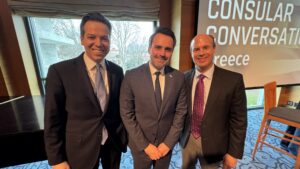
Greek Consul General Konstantinos Adamopoulos sat down with Global Atlanta’s Trevor Williams for a wide-ranging conversation covering Greece’s transformation from the center of the European debt crisis to a country now leading the Eurozone and what that means for businesses in Georgia and the Southeast.
A Career Shaped by Global Complexity
Consul General Adamopoulos came to diplomacy through an unlikely path. Growing up in Kalamata, Greece, he was inspired by an English teacher who had lived in Greenville, South Carolina, a connection that set him on a course toward international affairs, law and ultimately a fiercely competitive diplomatic service exam: 220 candidates competing for 20 positions over 20 consecutive days of oral examinations.
He passed, and since then his postings have taken him to London during the tumultuous Brexit period, where he helped manage the surge in Greeks seeking to secure their citizenship status and created new visa frameworks for British nationals with property and work ties to Greece, and then to Azerbaijan, where Greece holds strategic energy interests through the Trans-Adriatic Pipeline carrying Azerbaijani natural gas to southern Europe. Before arriving in Atlanta in 2022, he served in Athens’ Protocol Department, managing the intricate logistics of state visits from foreign heads of government.
“What you see as a 24-hour visit may take 10 or 15 days of preparation,” he said of that role. “You work with every kind of bureaucracy — Northern European, Middle Eastern, North American — and learn how each one operates.”
From Crisis to Surplus: The Greek Economic Transformation
The headline story from this conversation, and the most striking takeaway for Georgia business leaders, is just how dramatically Greece’s fiscal situation has changed. The country that was once the cautionary symbol of European debt excess has now recorded six consecutive years of budget surplus.
In December 2025, Greece’s Finance Minister was elected President of the Eurogroup, the governing body of all Eurozone nations, representing the bloc at both the G20 and the WTO. That a country that required an international bailout just over a decade ago now leads the Eurozone’s fiscal governance body speaks volumes about how thoroughly the situation has changed.
“The country that was not the good student is now leading the Eurozone. Things have totally changed, Adamopoulos told the lunch crowd.
How did Greece get here? The consul general pointed to several interlocking reforms: the creation of an independent tax collection authority insulated from political interference, new EU-level fiscal watchdogs created in the wake of the crisis, a complete overhaul of the national statistics system and a sweeping digital transformation of public services, a project now held up by European media as a model for other governments. The debt-to-GDP ratio has fallen from over 165% to 148% and continues to decline as GDP grows and the budget stays in surplus.
Equally notable: as the economy has stabilized, the political polarization that peaked during the crisis years has receded. Greece went from a fractured multi-party parliament with far-right and far-left surges to a more stable political environment without ever changing its constitution or democratic institutions.
Greece’s Strategic Role in the Western Alliance
Greece’s case to American partners isn’t only economic. Geographically, Athens sits closer to Baghdad than to Brussels, just one hour and fifty minutes by air from Iraq’s capital, making it one of NATO’s most strategically positioned members in the Eastern Mediterranean. The United States has maintained a major naval base at Souda Bay in Crete for decades, and recently established an additional logistics base in northern Greece at Alexandroupolis, which also hosts energy infrastructure supporting Eastern European countries during a period of acute supply uncertainty.
Greece operates one of NATO’s largest armored forces, approximately 1,300 tanks, more than Germany, the UK and France combined, and is currently implementing an Agenda 2030 modernization program focused on technological upgrades, new naval frigates and participation in the F-35 program. On NATO cohesion, the consul general was direct: dialogue and the decades-long record of successful alliance cooperation provide a strong foundation for working through any current tensions.
Investment and Trade: What Georgia Businesses Should Know
For companies and investors exploring Greece, the consul general outlined a clear landscape of incentives and entry points:
Investment Law Incentives: Investments of $10–20 million (depending on region) qualify for tax incentives and a dedicated government liaison to fast-track permits and regulatory approvals.
Innovation Hubs: Thessaloniki and Athens both offer tech-focused innovation zones with real estate and tax incentives for startups. Athens is anchoring a new 8 billion euro development that will serve as a major startup ecosystem.
Enterprise Greece: A semi-independent public entity, staffed partly from the private sector, that helps foreign investors navigate opportunities and procedures — backed by strong trade team resources at the Greek Embassy in Washington, D.C.
Golden Visa / Residency by Investment: The program has expanded beyond real estate to include company and startup investments. Thresholds vary by zone; for high-demand areas like Athens, the real estate threshold is now €800,000.
Workforce: Roughly 90% of Greeks under 60 speak English at a working level; many hold degrees from UK, Dutch and German universities. Labor costs are lower than Northern Europe with comparable educational attainment.
The consul general was clear about Greece’s strategic goal: attracting international companies to establish their European branch operations in Greece, particularly in technology, fintech, AI, renewable energy and logistics. The pitch combines a lower-cost, highly educated EU-based workforce with a markedly improved regulatory environment.
Greece and Georgia
The Greek community’s roots in Georgia go back more than a century. The Greek Orthodox Metropolis of Atlanta, the Greek orthodox church archdiocese headquartered here, oversees more than ten states. American Hellenic Educational Progressive Association (AHEPA), one of the oldest Greek diaspora organizations in the United States, was founded in Atlanta in 1922.
On the commercial side, Intralot, a major Greek gaming technology company, operates from Duluth, Georgia, and partners with state lottery systems across the country. Terna, a large Greek construction and renewable energy firm, also has a regional presence. The consul general expressed genuine interest in growing the commercial relationship further and encouraged Georgia businesses to reach out through the consulate or the Embassy’s trade team in Washington.
Cultural and academic ties are strengthening as well. The Carlos Museum at Emory recently participated in the repatriation of Greek artifacts, and discussions are underway with Georgia Tech and other universities about study-abroad programming in Greece.
Miller & Martin Insights: Lessons from Greece for Business Leaders
Kevin Abernethy, a government affairs, corporate and litigation attorney at Miller & Martin, offered his key takeaways. The one that resonated most strongly: Greece’s fiscal turnaround is not just an economic data point; it’s a case study in institutional reform and political will that holds lessons well beyond Europe.
“When you think of Greece, a lot of times people refer back to a financial crisis and a default,” Abernethy said. “The country literally defaulted, and now they’re running balanced budgets and surpluses for the past six years. I think that says a lot about their politics, their political system, their economy and where the country is positioned for the future.”
Abernethy also drew a broader lesson for businesses navigating political uncertainty at home. Greece rebuilt through a period of intense polarization and emerged with a more stable democratic system on the other side. “Greece seems to have broken through that and shown us the way a little bit,” he said. “I think there are good lessons for our domestic policies and politics that we can take from Greece.”
For Miller & Martin clients exploring international opportunities, Greece’s combination of EU membership, English-speaking workforce, improving infrastructure and competitive costs makes it worth a serious look, particularly for companies seeking a European base in technology, professional services or renewable energy.
Global Atlanta’s Consular Conversations series is presented and sponsored by Miller & Martin PLLC. The series provides a platform for foreign diplomats to discuss their countries’ economic priorities and bilateral relationships with the United States.

Consul: After Dim Period, Greece Ready for Investment Limelight
Consular Conversation Recap: Greece Writes a New Story, Invites Investors to Take Second Look